

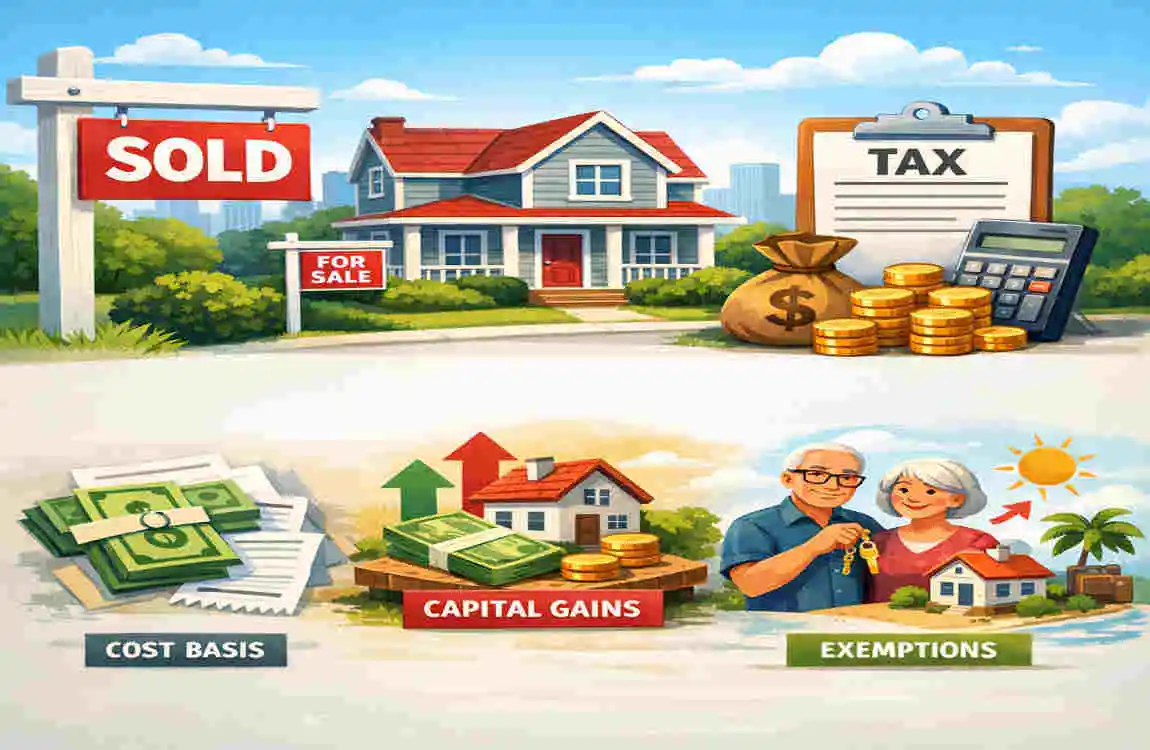
If you are asking whether, when selling a house, you pay taxes, the simple answer is: sometimes yes, sometimes no. In many cases, homeowners do not owe federal tax on the full sale amount. What matters is whether you made a taxable gain after accounting for your home’s cost, selling expenses, and any home sale tax exclusion you qualify for.
That is why the tax rules for selling a house can feel confusing at first. The number you sell for is not the same thing as your taxable profit. The tax calculation considers the sale price, selling costs, adjusted basis, and the amount of gain you retained after exclusions.
How Taxes Work When You Sell a House
Understanding Capital Gains
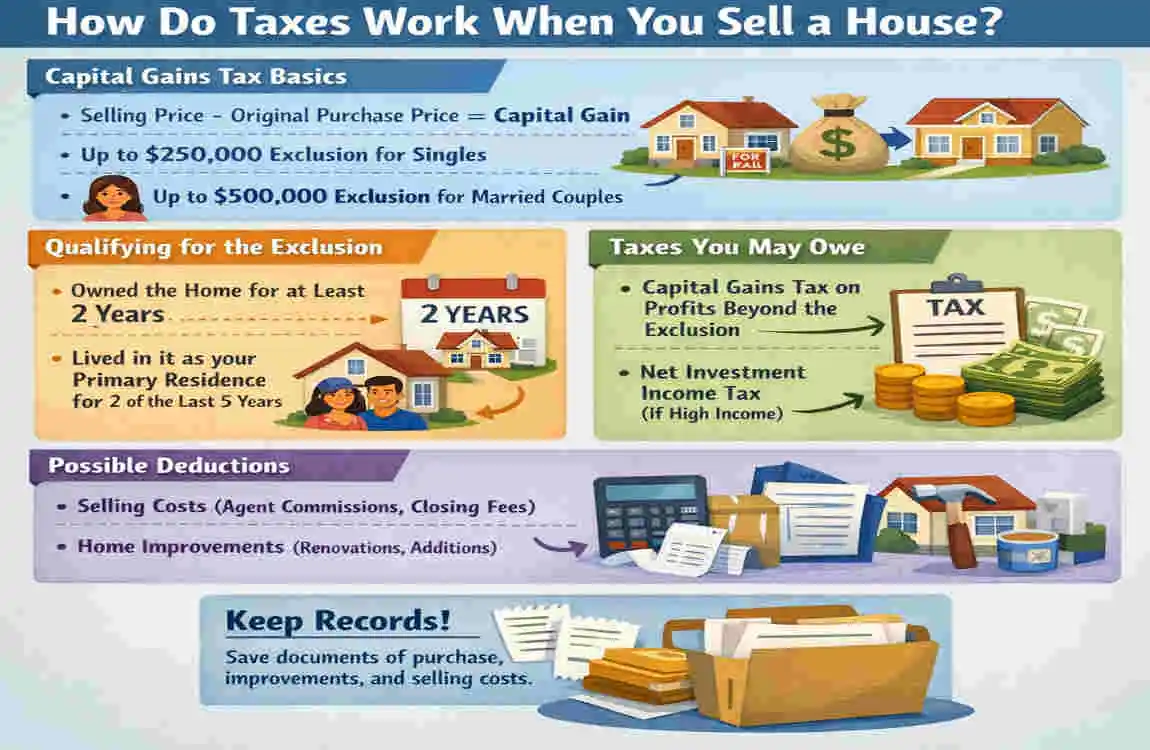
When people talk about tax on selling property, they usually mean capital gains tax. A capital gain is simply the profit you make when you sell something for more than your adjusted cost basis.
For a house, the basic idea is this:
Sale proceeds minus selling expenses minus adjusted basis equals gain
That gain is the starting point for tax rules. It does not always mean you owe tax on the full amount. In fact, many sellers reduce or eliminate the taxable part through exclusions and basis adjustments.
Your adjusted basis usually starts with what you paid for the home. It can increase if you made qualifying home improvements, and it can change for other reasons too. That is why keeping records matters so much.
Sale Price vs. Taxable Profit
A lot of homeowners assume that if they sell for more than they paid, the whole difference is taxable. That is not how it works.
Here is a simple example:
- You bought a home for $250,000
- You spent $40,000 on qualifying improvements
- Your adjusted basis becomes $290,000
- You sell the home for $400,000
- You pay $20,000 in selling expenses
Your gain is not $150,000 just because the sale price was higher than the purchase price. The real calculation is based on adjusted basis and selling expenses.
This is why receipts, closing documents, and repair records are so useful. They help prove your numbers if you ever need them later.
Does Paying Off the Mortgage Create a Tax?
No. Paying off your mortgage is not the same thing as paying tax.
The tax rule looks at the gain on the sale, not the remaining mortgage balance. If you sell a home for $400,000 and use part of the money to pay off the loan, that loan payoff does not automatically create a tax bill.
In other words, the tax calculation focuses on profit, not simply the cash left after the mortgage is paid.
Home Sale Tax Exclusion: When You May Not Owe Tax
The $250,000 Exclusion
For many homeowners, the most helpful rule is the home sale tax exclusion. If you qualify, you may be able to exclude up to $250,000 of gain from federal tax.
That means if your qualifying gain is under that limit, you may owe no federal capital gains tax on the sale. But remember, this applies to gain, not the full sale price.
The $500,000 Married-Filing-Jointly Exclusion
If you are married and file jointly, you may qualify for an exclusion of up to $500,000 of gain.
That sounds simple, but there are rules. Both spouses usually need to meet the ownership and use requirements, and the home must generally be your main home. So do not assume every married couple automatically gets the full amount.
Ownership and Use Requirements
To qualify for the main-home exclusion, homeowners usually must meet the 2-out-of-5-year rule. In plain language, that means you must have:
- Owned the home for at least two years
- Lived in the home as your main residence for at least two years
- Within the five years before the sale
These two years do not have to be continuous, but they must fall inside that five-year window.
There are some exceptions and special cases, so this rule is not the whole story. Still, it is the main starting point for most sellers.
When You May Have to Pay Tax on a Home Sale
Selling a Second Home or Investment Property
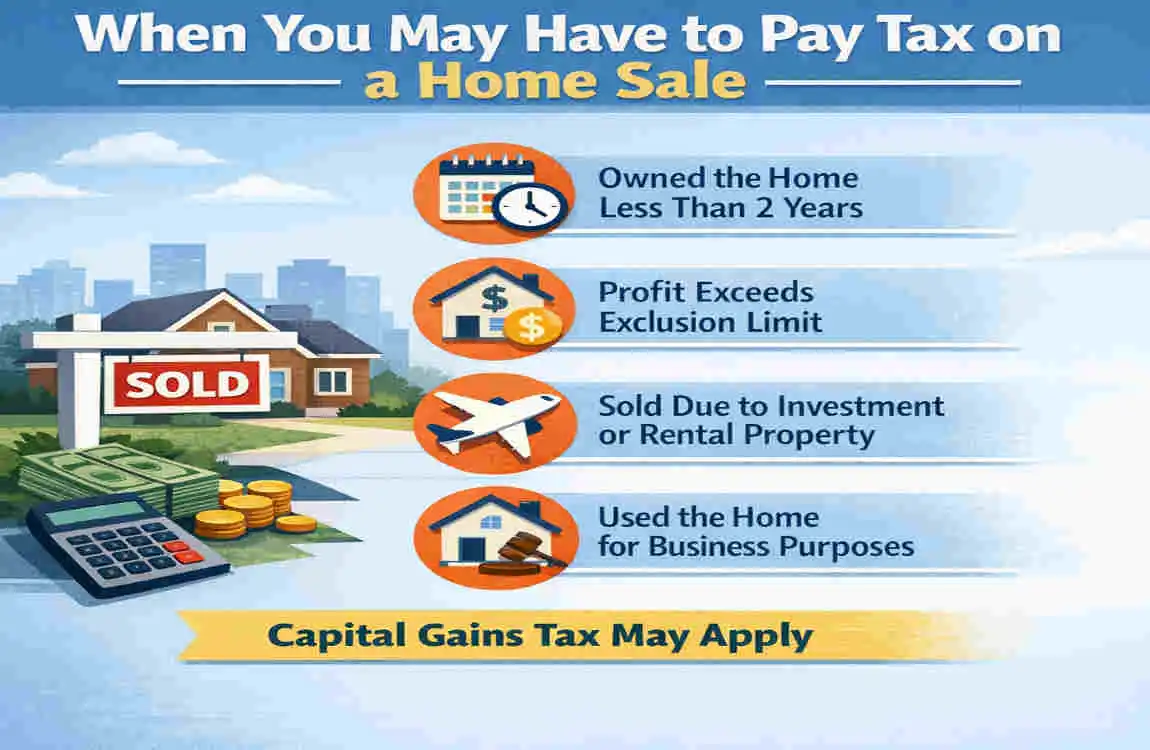
The main home exclusion usually does not apply the same way to second homes and investment properties. If the property was a vacation home, rental home, or other investment, the tax treatment can be very different.
That is because the government sees personal-use homes and income-producing properties differently. If you used the place for rent or business, you may have additional tax rules to consider.
Profit Above the Exclusion Amount
Even if you qualify for the main-home exclusion, you may still owe tax on any gain above the limit.
For example, if you are single and your taxable gain is more than $250,000, the amount above that threshold may be taxable. If you are married filing jointly and your gain exceeds $500,000, the excess may be taxable as well.
This is one reason sellers with large gains should slow down and run the numbers carefully.
Special Situations
Some homeowners may qualify for a partial exclusion or special tax treatment in certain situations. These can include cases involving:
- Divorce
- Disability
- Military service
- Rental use
- Business use
- Unusual life events
These situations can change the way the exclusion works. If your case is not standard, it is worth asking a tax professional before you close.
How to Calculate Your Taxable Gain
Start With Your Adjusted Basis
Your adjusted basis is the foundation of the calculation. It usually begins with the price you paid for the home.
Then you may add qualifying improvements that increase the home’s value or extend its life. These are not regular repairs like fixing a leak or painting a room. They are more often larger improvements, such as a new roof, a room addition, or a major remodel.
Keeping records is very important here. If you do not have proof of your improvements, it may be harder to support your adjusted basis.
Subtract Selling Expenses
Not all sale costs count the same way, but many selling expenses can reduce the amount realized from the sale. These may include certain transaction-related costs.
Examples may include:
- Real estate commission
- Title-related fees
- Some closing costs
- Advertising or marketing costs tied to the sale
Because tax treatment can vary by fee, it helps to separate your costs carefully. A good closing statement can make this easier.
Apply Any Available Exclusion
Once you know your gain, you then apply any exclusion you qualify for.
A simple version of the calculation looks like this:
Sale proceeds
minus eligible selling expenses
minus adjusted basis
equals gain
Then:
Gain
minus applicable exclusion
equals potentially taxable gain
Simple Example
Here is a straightforward example:
- Sale price: $500,000
- Selling expenses: $30,000
- Adjusted basis: $350,000
Your gain would be:
$500,000 – $30,000 – $350,000 = $120,000
Suppose you qualify for the full exclusion; that gain may be fully excluded from federal tax. If you do not qualify, the gain may be taxable.
Reporting the Sale and Preparing for Tax Time
When You May Need to Report the Sale
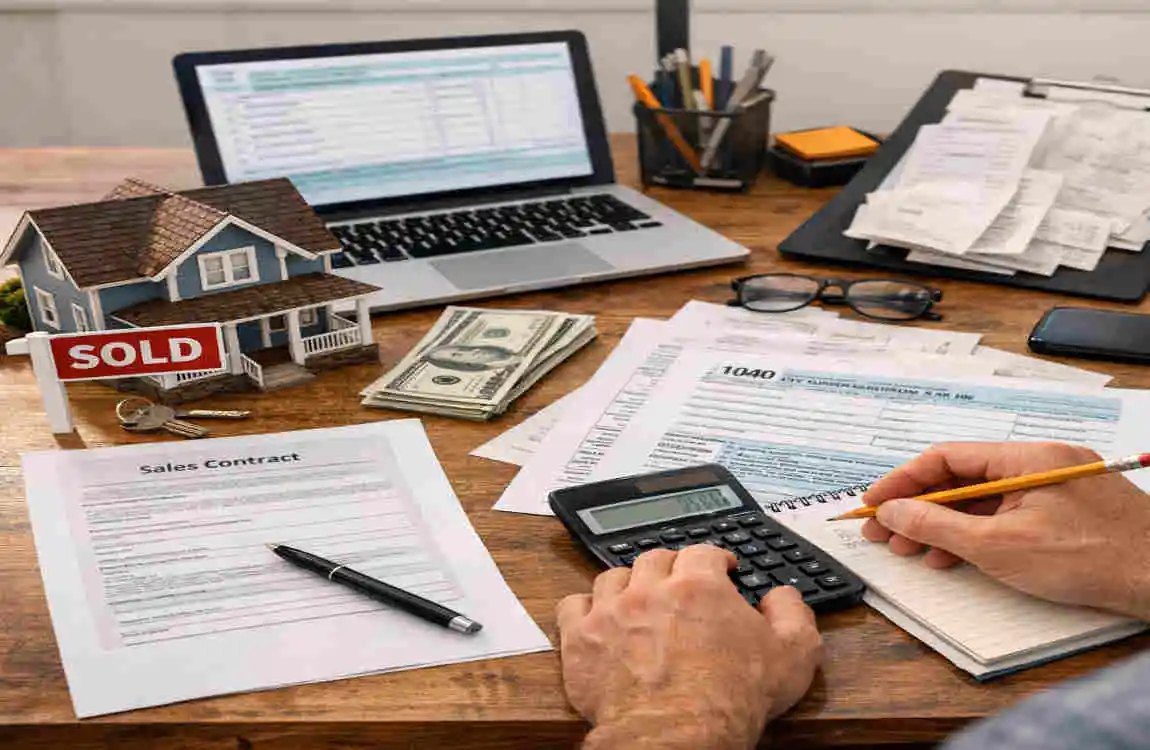
You may need to report the sale if a taxable gain remains. In some cases, you may also need to report the sale even if the gain is excluded.
One reason is Form 1099-S. If you receive it, the IRS may expect the sale to be reported on your tax return, even if the gain itself is not taxable.
Keep Important Documents
Good records make the whole process easier. Before and after the sale, keep:
- Purchase agreement
- Closing statement
- Records of major home improvements
- Selling expense records
- Property tax documents
- Form 1099-S, if you receive one
- Any documents that support your adjusted basis
These papers can help you calculate gain correctly and respond to questions later if needed.
Consider Estimated Taxes
If you end up with a significant taxable gain, it may affect your tax payment for the year. In some cases, people need to adjust withholding or make estimated tax payments.
This is especially important if the sale creates a larger tax bill than expected. Planning can help prevent a stressful tax season.
FAQ About Taxes When Selling a House
When selling a house, do you pay taxes?
You may pay taxes if you have a taxable gain after applying the rules and any exclusions you qualify for. Many primary-home sellers exclude some or all of that gain.
Do you pay taxes on the money from selling your house?
Not exactly. The tax is generally not based on the full cash you receive. It is based on your gain after subtracting your basis, selling expenses, and any allowed exclusion.
How long do you have to live in a house to avoid capital gains tax?
The general rule is the 2-out-of-5-year ownership-and-use test for the federal main home exclusion. You usually need to own and live in the home for at least two years within the five years leading up to the sale.
Do you pay taxes when selling a house at a loss?
For personal use in a home, a loss is generally not deductible. Different rules may apply if the property was used for business or investment.
Does selling a second home create a tax bill?
It can. Second homes usually do not get the same main-home exclusion, so the gain may be taxable depending on how the property was used and how long you owned it.
Do home improvements reduce taxes when selling?
Yes, they can. Qualifying improvements may increase your adjusted basis, thereby reducing the taxable gain. Keep receipts and records to support those costs.
| Key Point | Quick Information |
|---|---|
| What Is Tax on Selling a House? | A tax that may apply when you sell a property for a profit. |
| Capital Gains | The taxable gain is generally based on the selling price minus your adjusted purchase cost and eligible expenses. |
| Main Factors | Tax rules can depend on your country, ownership period, property use, and profit. |
| Possible Deductions | Certain improvement, selling, and transaction costs may reduce the taxable gain. |
| Primary Home | Some countries offer exemptions or relief when the property is your main residence. |
| How to Prepare | Keep purchase documents, improvement receipts, and selling expenses for accurate tax calculations. |
| Important Tip | Tax laws vary, so check your local rules or consult a qualified tax professional before selling. |
